No organization should lose the response after surviving the breach.
Detection has been solved a dozen times over. The response team that runs the incident has not. Organizations survive the breach itself, then lose the response. The wrong call made first, the regulatory clock nobody tracked, the record nobody can prove. IR-OS exists to close that gap.
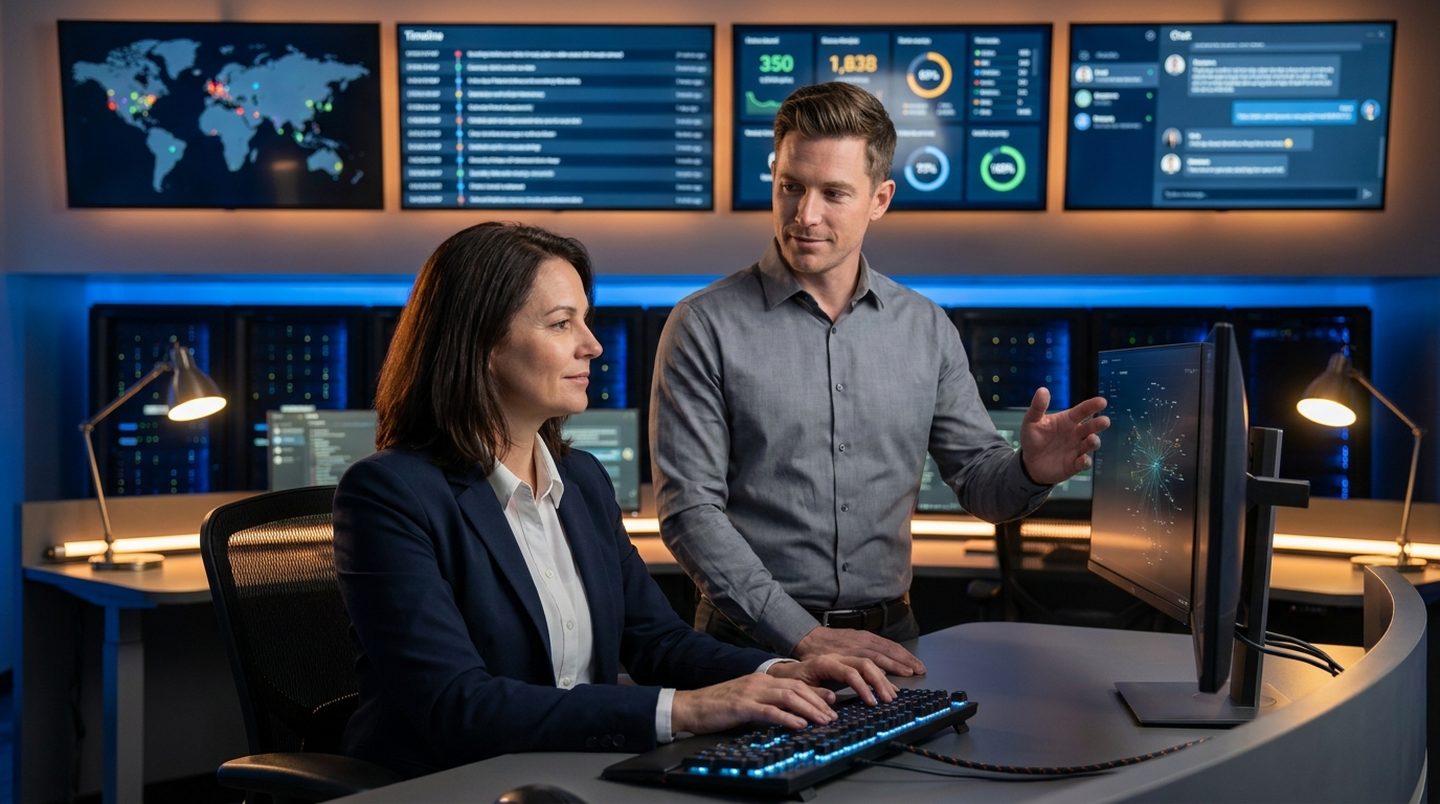
Mission
Make coordinated, provable incident response available to every organization. Not just the ones that can afford an incident response consultancy on retainer.
Vision
A world where no cyber incident is made worse by confusion. Every responder knows their next action. Every deadline is visible. Every decision is provable afterward.
Values
Receipts over narratives. Honesty over polish. Standards over invention. If we cannot prove a claim, we do not make it.
Why IR-OS exists
Most breach cost is not set by the malware. It is set by what the humans do in the first 72 hours after detection. Industry research has documented the pattern for years. IBM puts the average breach at $4.88M (2024), with 277 days to identify and contain. The cost concentrates in containment time, and containment time is a coordination problem.
The security industry answered with more detection. SIEM, EDR, XDR, each generation better than the last at telling you something is wrong. Almost nothing was built for the response setting where the incident actually gets run. The response setting where someone has to decide who calls counsel, who notifies the carrier, who briefs the board, and in what order, while the clocks are already counting down. That response setting ran on spreadsheets, Slack threads, a binder in a drawer, and improvisation.
The IR-OS team built the platform for that response setting. Cyber Incident Response Management is now a Gartner-recognized category, and IR-OS was purpose-built for it. Roles, decisions, regulatory clocks, stakeholder communications, and a cryptographically defensible record, all on one substrate.
What we are building toward
Readiness that compounds instead of decaying. Most organizations test their IR plan once a year, file the findings, and let the plan drift until the real incident arrives. We are building the opposite. A platform where the plan is computable, the drills are continuous, the findings become tracked remediation, and the same surface the team practices on is the one they command the real incident from.
And a record nobody has to take on faith. Every decision in IR-OS lands on an append-only, hash-chained ledger that anyone can verify at app.ir-os.com/verify, no account required. We believe the burden of proof in incident response should be carried by mathematics, not memory.
Data Privacy
We never use your data to train public models. Our business model is your response capability, not your information.
Data Ownership
Your organization's data is your organization's alone. It is stored privately and securely, and it leaves with you in standard formats whenever you choose.
The values, in practice
- Receipts over narratives. The defensible record is append-only by design. We refuse to build mid-flight redaction, even when customers ask. A record that can be edited after the fact is not a record.
- Honesty over polish. Our pricing is public. Our comparison pages say where competitors win. Our security page states plainly what we inherit from our SOC 2 Type II certified infrastructure providers and what we enforce in our own code. We would rather lose a deal than win it on a claim we cannot back.
- Standards over invention. Plans map to NIST SP 800-61 and ISO/IEC 27035. Runbooks serialize to OASIS CACAO 2.0. Threats tag to MITRE ATT&CK and D3FEND. We did not invent a proprietary methodology to lock you in. Your program runs on the standards your regulator and insurer already expect.
- Self-serve over sales theater. A platform that requires a six-figure procurement cycle to evaluate is not a platform for the response team. Signup to working IR plan takes about 15 minutes, and no sales call is required to see everything the platform does.
- AI that advises, humans who decide. Every AI surface in IR-OS is advisory, cited, and approval-gated. The models never train on customer content. The record proves exactly what the AI recommended and what the humans decided.
How the company runs
The IR-OS team is distributed and lean by design, and the company is built to outlast any individual. The platform runs on open standards, customer data is portable on demand in standard formats, and the incident record and IR plan belong to the customer, not to us. Revenue comes from subscriptions, with pricing published for the plans most teams need. We do not sell data, run ads, or monetize anything except the product working.
The platform is built and operated by the IR-OS team. An outside Advisory Board of cybersecurity practitioners and incident response leaders provides experience and product input without operating the platform day-to-day. Advisors do not have access to customer data, do not approve releases, and do not speak for IR-OS in any operational capacity. More on how we work is on the About page.
We also run our own incidents on IR-OS. Our chain carries the same integrity guarantees as yours, and the public verifier accepts our records. We ask customers to trust the platform with their worst day. We hold ourselves to the same bar.
Questions, answered
Who builds IR-OS?
The IR-OS team designs, builds, ships, and operates the platform, and owns the roadmap. An outside Advisory Board contributes practitioner experience and product input, nothing more.
How does IR-OS make money?
Subscriptions only. Three plans, two of them with published pricing, all with a 7-day free trial and a 30-day money-back guarantee. No ads, no data monetization, no paid placement.
What happens to our data if we leave?
It leaves with you. Incident records, plans, and exports are portable on demand in standard formats including JSON and PDF. The defensible record remains verifiable after export, with no IR-OS account required.
How do we verify your claims?
Test the hash-chain verifier at app.ir-os.com/verify. Read the State of IR Readiness 2026 research, free with no email wall. Check the comparison pages, including where competitors win. Review the security posture. Detailed security documentation is available to prospects under NDA.
See the mission in the product
Build your IR plan, assign your roles, and run your first tabletop this week. 7-day free trial. 30-day money-back guarantee. No sales call.
Start your 7-day free trial