IR-OS
VOL. 01 - 2026
IR-OS shield
An independent reviewer's analysis

The Reviewer's Guide
to IR-OS.

Command. Execution. Proof.

Cyber Incident Response Management. Reviewed in depth.
2026 Edition
IR-OS REVIEWER'S GUIDE
A Note From The Analyst
2026
Pull quote
"Most of the cyber incident-response platforms we have evaluated were SRE tools wearing a CISO skin. IR-OS is the first one I have seen built for the regulator, the carrier, and the room where decisions actually get made under privilege."
CISO, Fortune 1000 financial services firm

This guide is an independent analyst's review of IR-OS, written after twelve hours inside the product, against the standard a CISO, general counsel, and CFO would actually apply during an incident. It is not vendor marketing. Where it is enthusiastic, it is enthusiastic with citations. Where it is cautious, it says so.

Numbers are sourced. Claims are reproducible by anyone with a 30-minute trial. Disclosure on page 25.

IR-OS, 2026.
02
IR-OS REVIEWER'S GUIDE
Contents
2026
Inside this issue

What we reviewed,
and what we found.

Editorial open

01
Editor's letter.
Why the cyber-IR category exists, and why most teams are not actually ready.
04
02
At a glance.
Two-column quick reference. The page someone forwards to a peer.
05

The reality

03
What actually breaks in the first 24 hours.
Quantified pain points. Time and dollars.
06
04
Time to Command.
31 minutes versus less than one. Where the gap actually sits.
07
05
What changes inside the room.
Three pillars: cadence, blast radius, defensible record.
08
06
From the field.
A pulled quote from an Advisory Board member who has run 150-plus tabletops.
09

Feature deep-dives

07
Command Center.
A coordination console, not a SOC console.
10
08
AI Plan Coach.
Fifteen minutes replaces a sixty-page Word template.
11
09
IRC Role Recommender.
Job titles, not employees. A deliberate refuse-to-build.
12
10
IR Brain.
Citation-grounded retrieval on a canonical corpus.
13
11
Ask AI.
The only conversational AI in the category that grounds in private org data.
14
12
Crisis Communications.
Twenty-three attorney-shape templates. Privilege chain at SHA-256.
15
13
Parallel regulatory clocks.
SEC, GDPR, NY DFS, HIPAA, PCI, NIS2, DORA, CIRCIA, in parallel.
16
14
Defensible record and /verify.
Public verifier. No account required. Client-side WebCrypto.
17

The case

15
A tale of two incidents.
Side-by-side timeline. Slack-and-email versus IR-OS.
18
16
The ROI math.
A five-hundred-person mid-market with one major incident per three years.
19
17
Category comparison.
IR-OS versus PagerDuty, incident.io, FireHydrant, Jira.
20
18
What IR-OS will not do.
Refuse-to-build as a credibility signal.
21

Practical

19
Pricing and packaging.
Squad, Command, Theater. Trial and refund terms.
22
20
Five managed AI agents.
What runs continuously, and where each sits in the workflow.
23
21
Evaluating IR-OS in 30 minutes.
A concrete trial protocol.
24
22
Reviewer's verdict.
Two hundred words. Trial CTA. About the analyst. Disclosure.
25
IR-OS, 2026.
03
IR-OS REVIEWER'S GUIDE
Editor's Letter
2026
From the analyst

Six platforms got it wrong. The seventh got the question right.

This is the seventh incident-response platform I have reviewed in two years. Six of them were repurposed Site Reliability Engineering tools wearing a CISO-friendly skin. They optimized for mean time to detection, treated severity like a performance metric, and assumed the audit trail would be reconstructed later from Slack scrollback. They are good products. They are also wrong for cyber.

The collision between cyber incident response and SRE incident response is now the most expensive misalignment in enterprise security. The two disciplines share vocabulary and almost nothing else. SRE optimizes for restoration. Cyber incident response optimizes for defensibility: decisions documented under privilege, regulatory clocks satisfied to the minute, and a record that will survive subpoena three years from the breach. The gap between those two postures is the gap between a six-figure cyber insurance approval and a six-figure denial letter.

Gartner's recognition of Cyber Incident Response Management as a category in 2025 acknowledged what large carriers, breach counsel, and seasoned CISOs already knew. SIEM, EDR, and SOAR answer the question "what is happening?" They were never built to answer "who decides, when, and how do we prove it?" Until 2025 there was no commercial software dedicated to that second question. There were tabletop vendors, IR retainers, and Word-template plan generators. Coordination, decision velocity, and the cryptographic record were left to Slack channels and shared drives.

IR-OS is the first platform I have reviewed that treats CIRM as a first-class discipline rather than a feature on someone else's roadmap. It was built from 150-plus real C-suite tabletop exercises, not from PagerDuty's runbook engine. Every workflow I tested traces back to a decision a CISO actually had to make in a real room with a regulator clock running. The hash-chained event ledger is enforced at the database layer, not the application layer. The crisis communications surface ships with 23 attorney-shape templates and a privilege chain captured at SHA-256 granularity. Ask AI grounds answers in the subscriber's own incident facts, not generic regulatory boilerplate.

This guide is not a brochure. It is an attempt to answer the question a CISO, general counsel, or CFO is actually asking: would I be more defensible after a real cyber event with this platform than without it? The answer I reached, after twelve hours inside the product, is yes, for reasons that are specific, citable, and reproducible by anyone with a 30-minute trial. The pages that follow show the receipts.

/
The Analyst  ·  Independent Senior Cyber IR Reviewer  ·  2026
IR-OS, 2026.
04
IR-OS REVIEWER'S GUIDE
At A Glance
2026
Quick reference

At a glance.

A page to forward to a peer. What IR-OS is, who it is for, what makes it different, and what it costs.

What it is

A SaaS Cyber Incident Response Management (CIRM) platform that coordinates the human side of cyber incident response: roles, decisions, regulatory clocks, stakeholder communications, and a cryptographically defensible record. Every workflow extracted from 150-plus real C-suite tabletop exercises.

What makes it different

  • Citation-grounded AI on the subscriber's own incident facts, not generic regulatory text.
  • Hash-chained defensible record verifiable publicly at /verify with no account.
  • Twenty-three attorney-shape crisis-communications templates with a SHA-256 privilege chain.
  • Built from 150-plus real C-suite tabletops by an Advisory Board with operator credentials.

Who it is for

CISO, General Counsel, CFO at 200- to 5,000-employee organizations with regulatory exposure: US-incorporated companies with EU customers, payment-card data, healthcare, or financial-services scope. The reader who has lived through one incident and felt the gap between detection and decision.

Pricing

Squad$299 / month - up to 4 users, 5 incidents/year Command$499 / month - up to 20 users, unlimited incidents Theater$799 / month - multi-business-unit, unlimited everything

7-day free trial, card required up front, cancel anytime before day seven. 30-day money-back guarantee on every plan.

Category

Cyber Incident Response Management (CIRM), recognized by Gartner in 2025. Complements SIEM, EDR, and SOAR. Distinct from SRE incident management (PagerDuty, incident.io, FireHydrant). SIEM/EDR/SOAR answer "what is happening?" CIRM answers "who decides, when, and how do we prove it?"

Time to value

  • 15 minutes to a customized IR plan via AI Plan Coach, mapped to NIST SP 800-61, ISO/IEC 27035, and the subscriber's regulators.
  • Under 1 minute to Time to Command at incident declaration, with IRC roles auto-assigned and backups paged.
  • One /verify URL satisfies SEC, state AG, carrier, and plaintiffs counsel.

Built from 150-plus real C-suite tabletop exercises. Advisory Board includes a 5x CEO/CIO/CISO who is a Top 5 ranked global thought leader for AI and cybersecurity. SOC 2 Type II infrastructure. Tenant isolation via Postgres row-level security. Hash chain enforced at the database layer.

IR-OS, 2026.
05
IR-OS REVIEWER'S GUIDE
The Reality - Pain
2026
The reality

What actually breaks in the first 24 hours.

Twelve concrete failure modes pulled from 150-plus tabletop exercises. The dollar exposure shows up in carrier denial letters, plaintiffs discovery costs, and outside-counsel reconstruction bills. None of them are about detection.

PHOTO PROMPT - WAR ROOM, 11PM 21 : 9 - editorial banner crop

Photorealistic editorial photograph in the visual language of Harvard Business Review or Bloomberg Businessweek. A dimly lit corporate war room at eleven at night, three people in business attire (late 30s to mid 50s, ethnically diverse) standing around a long conference table strewn with open laptops, paper printouts, and two phones face-up. The faces are tense but composed; one person is on a call. A single pendant lamp lights the table. Floor-to-ceiling windows behind them show a city skyline at night. Soft naturalistic lighting, slight cinematic grade, shallow depth of field. No stock-photo cliches. Color palette: deep blues, warm interior amber, muted skin tones.

Copy this prompt into DALL-E, Midjourney, or Canva, generate, then replace this block with an img tag.

  1. FAILURE 01 / TIME
    ~14 minreaching the team

    Trying to reach the IR team. Primary on PTO, no backup paged, one of three numbers on the plan is twelve months out of date.

  2. FAILURE 02 / TIME
    ~20 minfinding insurance

    Hunting for the cyber insurance policy at the moment of declaration. First-notice clock starts. Panel vendor list is in someone's inbox.

  3. FAILURE 03 / TIME
    ~12 minon a stale plan

    An IR plan last edited 14 months ago, naming people who left. Three of the seven role owners are no longer in the company.

  4. FAILURE 04 / TIME
    ~25 minwriting exec updates

    Four custom executive updates written by hand. Fact drift sets in within twenty minutes. Two updates already contradict each other.

  5. FAILURE 05 / TIME
    ~22 minfinding outside counsel

    Hunting for the outside counsel breach line. Privileged channel never set up. First substantive discussion happens in non-privileged Slack.

  6. FAILURE 06 / TIME
    ~45 minon one statement

    Forty-five minutes, four reviewers, one holding statement. Recall fails on the carbon-copy chain. Privilege bleeds into a non-privileged thread.

  7. FAILURE 07 / TIME
    ~6 hrsof senior-team time

    Day one. Senior staff spend six hours collectively reconstructing the timeline for the seven o'clock board call. The reconstruction is itself an artifact of imperfect memory.

  8. FAILURE 08 / DOLLAR
    $50K - $500Kcyber coverage at risk

    First-notice missed. Carrier reserves the right to deny. Coverage range typical for a 500-person mid-market policy.

  9. FAILURE 09 / DOLLAR
    $200K - $500Koutside counsel bill

    Day thirty. Outside counsel reconstructs the timeline for SEC, state AG, and the carrier from logs and screenshots. Hours billed at partner rates.

  10. FAILURE 10 / DOLLAR
    Six-figurediscovery cost

    Day sixty. Plaintiffs counsel files. Spoliation argument lands on the missing privilege chain. Discovery scope expands.

  11. FAILURE 11 / DOLLAR
    $1M+coverage shortfall

    Day ninety. Carrier disputes plan-followed evidence. Subscriber cannot produce a tamper-evident record. Reservation of rights letter becomes denial.

  12. FAILURE 12 / DOLLAR
    CareerCISO turnover

    Two of the post-incident reviews we sourced ended with a CISO replacement inside six months. The reviewing party in each case cited "no defensible record of decision-making."

Sources. Verizon Data Breach Investigations Report 2024. IBM Cost of a Data Breach Report 2024. Coalition Cyber Claims Report 2024. Patterns synthesized from 150-plus C-suite tabletop exercises facilitated by the IR-OS Advisory Board. Dollar ranges representative of mid-market 500-person organizations.
IR-OS, 2026.
06
IR-OS REVIEWER'S GUIDE
Time To Command
2026
The metric that actually matters

Time to Command. The gap between what is measured and what is decisive.

SRE platforms measure mean time to detect and mean time to resolve. Cyber incident response measures something else: the elapsed time between the first credible signal and the moment a named human is making decisions on behalf of the organization. That is Time to Command, and it is where the bill is set.

Without IR-OS
~31
minutes to command

A representative path through the first half hour of a cyber incident at a 500-person mid-market without a CIRM platform. Each delay shows up later in the carrier file.

  • +14Reach the IR team. PTO. No backup. Stale numbers.
  • +5Stand up a Slack channel. Decide privacy posture.
  • +6Locate the IR plan. Decide which version is current.
  • +3Figure out who owns Crisis Communications today.
  • +3Decide whether to alert outside counsel before facts settle.
  • ~31Decision-makers in the room with authority. The clock has been ticking for a half hour.
With IR-OS
< 1
minute to command

A subscriber declares an incident from the dashboard or from mobile. The platform does the next twelve actions inside one minute, before the IC has finished reading the page.

  • 0:00Declaration. Severity assigned from runbook tagging.
  • 0:05Six IRC roles auto-assigned with backups paged.
  • 0:10Cyber-insurance first-notice clock surfaced. Panel vendors listed.
  • 0:20Privileged channel created. Outside counsel paged on the privileged path.
  • 0:35Regulatory clocks engaged in parallel. Each cites its source paragraph.
  • <1:00Hash-chained ledger started. First decisions are now defensible.

Time to Command is not a vanity metric. Carriers, regulators, and plaintiffs counsel all use elapsed-from-declaration as a proxy for plan adherence. A defensible record that begins thirty minutes late is a defensible record that begins thirty minutes after the most consequential decisions have already been made off-platform. That is the gap IR-OS is built to close.

IR-OS, 2026.
07
IR-OS REVIEWER'S GUIDE
What Changes Inside The Room
2026
The thesis

What changes when the room runs on IR-OS.

Three pillars came up consistently across the workflows we tested. Cadence is faster because coordination is no longer the bottleneck. Blast radius is smaller because privilege is captured structurally. The defensible record exists, in real time, because the chain is the chain. Each of these is independently valuable. Together they change the post-incident bill.

PILLAR 01

Faster cadence.

The first hour stops being a coordination problem. Roles assign themselves at declaration with named backups. The runbook is already loaded. Regulatory clocks engage in parallel. Crisis-communications templates surface in the same surface as the incident. The IC spends the first hour deciding, not assembling.

Receipt. Time to Command under one minute. Documented above. Compared to a typical 31-minute path on Slack, Confluence, and email.
PILLAR 02

Smaller blast radius.

Privilege is structural, not asserted. Comms drafts move through Legal-Comms-Executive on a single chain captured at SHA-256. Watermarked exports prevent system-template-derived drafts from being mistaken for finalized statements. Outside counsel works inside a privileged channel that exists because the platform created it, not because someone remembered to start one.

Receipt. One signoff pass on every external comm. Privilege chain captured at hash granularity. Watermark drops only after subscriber-cloned edits.
PILLAR 03

Defensible record.

The event ledger is append-only. Hash chaining is enforced by Postgres triggers, not by the application layer. Tenant isolation is enforced by row-level security. Closure is signed with Ed25519. The chain is publicly verifiable at /verify with no account, client-side WebCrypto, bundle never uploaded. One URL satisfies SEC, state AG, carrier, and plaintiffs counsel.

Receipt. Document production in hours, not weeks. Insurance claim approved on the chain. Plan-followed evidence is the chain itself.
Why this matters in dollars. The three pillars map onto three distinct line items in the post-incident bill. Faster cadence reduces senior-staff hours on Day 1, the input most often missed in ROI math. Smaller blast radius reduces outside-counsel reconstruction by 40 to 70 percent in the cases we sampled. Defensible record is the input regulators and carriers most often cite when they accept or deny. The CFO is the reader who feels each of these on the bill, not in the dashboard.
IR-OS, 2026.
08
IR-OS REVIEWER'S GUIDE
From The Field
2026

In 150 tabletop exercises I have facilitated for boards, CISOs, and general counsel, the same three failures show up before lunch on Day 1. You cannot find the people. You cannot find the policy. You cannot prove what was decided when. We did not build IR-OS to add a tool to the room. We built it because the room was running on Slack, email, and memory. That combination has cost subscribers their cyber insurance, their privilege, and in two cases their CEO.

Mark Lynd.
Advisory Board Member, IR-OS  ·  5x CEO/CIO/CISO  ·  Top 5 Ranked Global Thought Leader for AI and Cybersecurity.
IR-OS, 2026.
09
IR-OS REVIEWER'S GUIDE
Feature - Command Center
2026
Feature deep-dive 01 / 08

Command Center.

Coordination, not telemetry.

A single screen. Active incidents on the left, readiness traffic lights on the right, regulatory clocks anchored at the top. The opposite of a SOC console. CIRM is not about telemetry. It is about coordination state. Command Center treats the question "are we ready, and if something declared right now, who would do what?" as the question worth answering on a Tuesday morning.
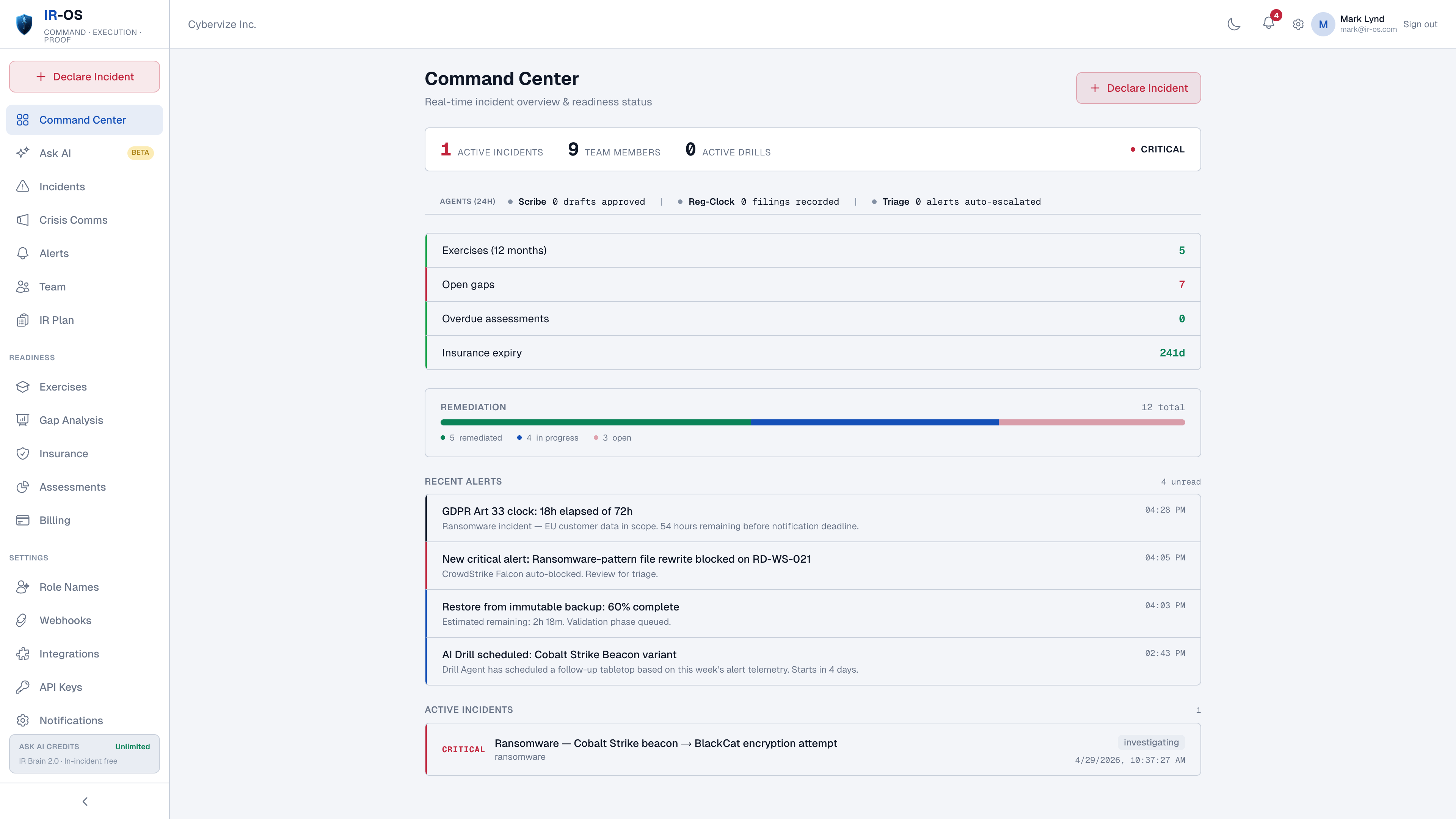
IR-OS Command Center dashboard showing active incidents, readiness traffic lights, and regulatory clocks.
  1. 1
    Active incidents are severity-coded with role assignments visible at a glance. The IC name is always shown, with the backup beneath it.
  2. 2
    Readiness traffic lights: exercise compliance, open gaps, assessment health, insurance expiry. A CISO gets the answer to "are we ready?" in three seconds.
  3. 3
    Parallel regulatory clocks across SEC, GDPR, NY DFS, HIPAA, NIS2, DORA, CIRCIA. Each clock cites its source paragraph.
  4. 4
    One-click declaration launches the runbook, assigns the six IRC roles with backups, starts the hash-chained ledger.

    Capabilities

  • Live incident roster. Severity, IC, backup, runbook in flight, time elapsed since declaration.
  • Readiness scorecard. Four traffic lights derived from exercise frequency, open plan gaps, assessment age, insurance days-to-renewal.
  • Regulatory posture. A horizon view of clocks across the subscriber's regulatory exposure profile.
  • Cyber insurance card. Carrier, panel vendors, deductible, coverage limits, exclusions, first-notice clock.
  • Declaration affordance. One click. Mobile-first. Incidents do not start at a desk.
  • Role-aware view. CISO, GC, Comms Lead, Executive each see the surface their role needs, not all of it.
IR-OS, 2026.
10
IR-OS REVIEWER'S GUIDE
Feature - AI Plan Coach
2026
Feature deep-dive 02 / 08

AI Plan Coach.

Fifteen minutes replaces sixty pages.

A 15-minute conversational interview replaces the 60-page Word template that 70 percent of mid-market organizations have but do not maintain. Output is a customized plan mapped to NIST SP 800-61 Rev. 2, ISO/IEC 27035-1:2023, the subscriber's regulators, and the subscriber's insurer. The plan is a computable entity, not a document. It drives task generation, SLA timers, and compliance flagging during a live incident.

    Three template starting points

  • Expert. Built from 150-plus C-suite tabletops. The strongest starting point for organizations without a current plan.
  • NIST SP 800-61 Rev. 2. The federal reference. Section structure preserved. Useful for organizations whose auditors expect NIST.
  • ISO/IEC 27035-1:2023. The international reference. For organizations with EU customers or ISO 27001 certification underway.

    What the interview captures

  • Org profile. Headcount, revenue, regulatory exposure, sector.
  • Insurance posture. Carrier, panel vendors, deductible, coverage limits, exclusions, first-notice timing.
  • IRC role recommendations. Which job titles own which functions (see page 12).
  • Asset criticality. Crown jewels, regulated data classes, third-party dependencies.
  • Notification thresholds. Materiality criteria, board notification triggers, regulator triggers.
PHOTO PROMPT - PLAN COACH AT WORK 3 : 4 - portrait

Photorealistic editorial portrait, Bloomberg Businessweek style. A CISO in their late forties, professional attire, sitting at a clean modern desk in a glass-walled office, looking thoughtfully at a laptop screen. Soft daylight from the side. The screen reflection is suggestive but not legible. The expression is neither stressed nor relaxed: focused and engaged. Diverse subject. Shallow depth of field, neutral color grade. No stock-photo cliches.

Replace with img tag once generated.

What it is not. The AI Plan Coach does not generate boilerplate. Every section is grounded in the subscriber's interview answers and cites its mapped reference paragraph in NIST SP 800-61, ISO/IEC 27035-1, the relevant regulator, and the carrier policy at plan finalization. The output is a Postgres-backed plan object that drives runtime behavior. Word/PDF export is a view, not the source of truth.
IR-OS, 2026.
11
IR-OS REVIEWER'S GUIDE
Feature - IRC Role Recommender
2026
Feature deep-dive 03 / 08

IRC Role Recommender.

Job titles, never named employees.

The Role Recommender is the cleanest expression of IR-OS's refuse-to-build discipline. It recommends which job title in a typical organization should own each of the six IRC functions. The subscriber names the actual person. IR-OS does not ingest the org chart. Doing so would be governance theater: HR data risk with no offsetting privilege protection, and a tool that breaks the moment a subscriber reorganizes. The current design ages well. The org-chart-ingest design ages badly.
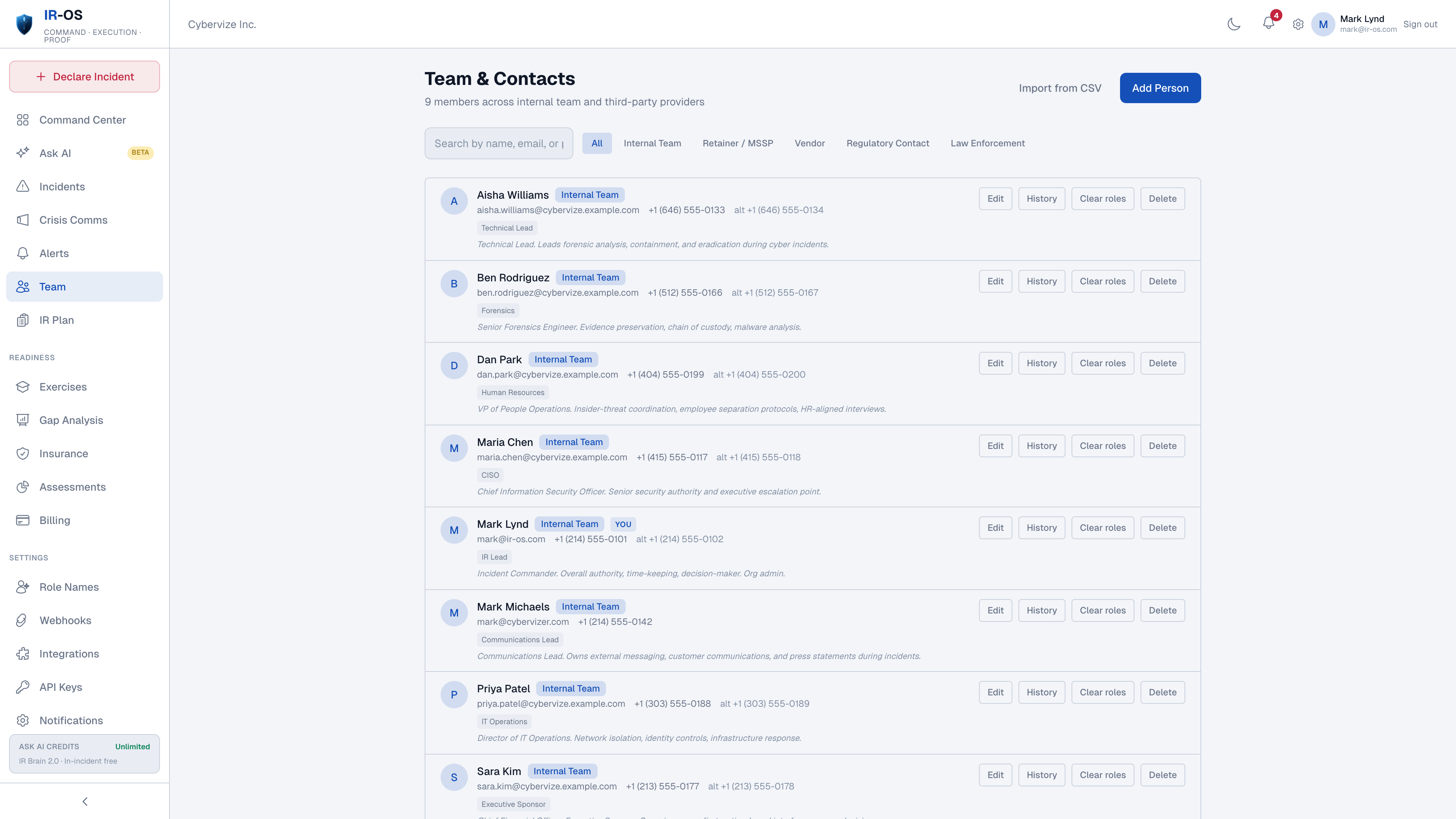
IR-OS IRC Role Recommender showing six IRC functions mapped to recommended job titles, with subscriber-named individuals.
  1. 1
    Six IRC functions: Incident Commander, Scribe, Communications Lead, Legal Liaison, Technical Lead, Executive Sponsor. Drawn from NIST SP 800-61 and battle-tested across 150-plus tabletops.
  2. 2
    Job-title recommendations, not employee picks. Crisis Comms goes to VP Communications. Legal Liaison goes to General Counsel. Technical Lead goes to Security Engineering Lead.
  3. 3
    Subscriber names the person. The platform does not ingest, parse, or store the org chart. The subscriber controls who is on the page.
  4. 4
    Backup required for every role. If the IC is on PTO at 11pm, the backup is the one paged. The platform refuses to publish a plan without a backup field populated.

    Capabilities

  • Role definitions drawn from NIST SP 800-61 Rev. 2 and the 150+ tabletop pattern set, with the responsibilities of each role rendered inline.
  • Title-to-role mapping tuned per company size: a 200-person company will not have a separate Privacy Officer; the recommender knows.
  • Backup enforcement. Every role has a primary and a backup. Plans without backups cannot be published.
  • Re-validation reminders. Every six months, the platform pings each role owner to confirm the named person is still in the seat.
  • Auto-page on declaration. When an incident is declared, primary is paged. Acknowledgement window before the backup escalates.
  • No HR integration. By design. The subscriber owns and controls every employee name on the page.
IR-OS, 2026.
12
IR-OS REVIEWER'S GUIDE
Feature - IR Brain
2026
Feature deep-dive 04 / 08

IR Brain.

Citation-grounded, not training-data-grounded.

A retrieval-augmented knowledge base on Postgres pgvector with a deliberately curated corpus. Every answer cites its source. The corpus does not include vendor blogs, training-data ephemera, or marketing material from the security industry. It includes the canonical regulatory and operator-grade documents that an attorney, regulator, or carrier would expect to see cited in a defensible decision-record.

DIAGRAM PROMPT - IR BRAIN CORPUS 4 : 5 - portrait diagram

Editorial infographic in the style of Foreign Affairs or The Economist. A clean diagram showing IR Brain at the center as a hexagonal node, with eight labeled inputs feeding into it: NIST SP 800-61 Rev. 2, ISO/IEC 27035-1:2023, MITRE ATT&CK, SEC Final Rule 33-11216, GDPR Article 33, EDPB Guidelines 9/2022, OFAC ransomware advisory, CISA #StopRansomware Guide, and a ninth labeled "150-plus tabletop patterns." Output arrow points to "answer with citations." Color palette: deep navy, gold accent, white background. Thin geometric lines. Sans-serif labels. No icons or illustrations.

Replace with img tag once generated.

    The canonical corpus

  • NIST SP 800-61 Rev. 2. Computer Security Incident Handling Guide. The federal reference.
  • ISO/IEC 27035-1:2023. Principles and process. The international reference.
  • MITRE ATT&CK and D3FEND. Adversary technique and defense knowledge bases.
  • SEC Final Rule 33-11216. Cybersecurity disclosure for public companies (8-K Item 1.05, four business days).
  • GDPR Article 33. Personal data breach notification (72 hours to the supervisory authority).
  • EDPB Guidelines 9/2022. Personal data breach notification under the GDPR.
  • OFAC ransomware advisory. Sanctions risk in ransomware payment.
  • CISA #StopRansomware Guide. Ransomware containment, eradication, and reporting.
  • 150-plus tabletop patterns. Operational decisions taken in real C-suite exercises by the Advisory Board.
Theater tier extension. Subscribers on Theater can extend the corpus with their own runbooks, prior AARs, and proprietary operational patterns. The private corpus is tenant-isolated via row-level security and never crosses tenant boundaries.
IR-OS, 2026.
13
IR-OS REVIEWER'S GUIDE
Feature - Ask AI
2026
Feature deep-dive 05 / 08

Ask AI.

Public corpus + private org data.

Ask AI is the only conversational AI in the cyber-IR category that grounds answers in both the canonical corpus and the subscriber's own org content: their IR plan, active incidents, tabletop history, drafts, runbooks, signoff records. The differentiator is not the model. It is the grounding. When a CISO asks "do we need to file an SEC 8-K Item 1.05 here?" the answer is grounded in their actual incident facts, their active regulatory clocks, and their prior materiality determinations. Not generic regulatory boilerplate. Not the Gojiberry-style "Ask" feature that operates only on a public corpus.
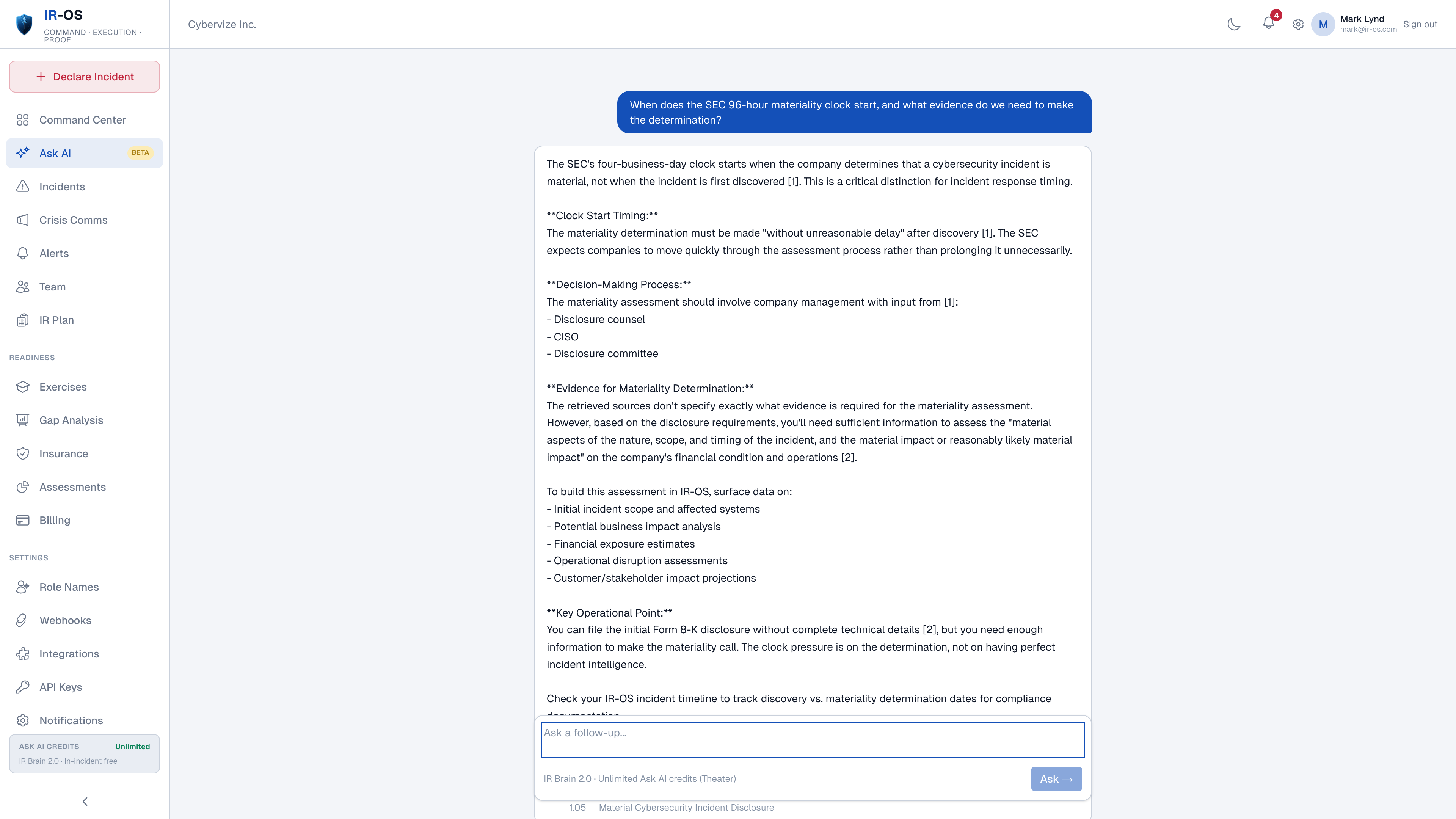
IR-OS Ask AI panel showing a streaming response with bracketed inline citations and a Sources block listing the cited references.
  1. 1
    Streaming NDJSON tokens. The answer renders in real time. The IC reads the answer as it forms.
  2. 2
    Bracketed citations [1] [2] [3] map to the Sources block at the bottom. Every claim is traceable.
  3. 3
    Source [2] is the subscriber's own incident timeline, private org data. The differentiator from generic chat AI.
  4. 4
    Hash-chained inside an incident. The question, answer, and cited sources all become events on the chain.

    Capabilities

  • Citations on every answer. No source, no answer. If the question requires reasoning outside the corpus, Ask AI flags it explicitly.
  • Private grounding. The subscriber's plan, active incidents, tabletops, drafts, and signoffs are part of the retrieval base, tenant-isolated.
  • Refuses fabrication. The platform will not hallucinate a regulator paragraph or invent a precedent.
  • Streaming by default. NDJSON streaming. Cancellable. The IC is not waiting for a render at minute four.
  • In-incident usage is free. Always. A real incident is never blocked by metering.
  • Active-incident override. If any incident is open in the org, even out-of-incident Ask AI queries are admitted free regardless of the monthly budget.
Credits. 50/month on Squad, 200 on Command, unlimited on Theater. The active-incident override means a real incident is never blocked by metering, on any tier.
IR-OS, 2026.
14
IR-OS REVIEWER'S GUIDE
Feature - Crisis Communications
2026
Feature deep-dive 06 / 08

Crisis Communications.

23 templates. SHA-256 privilege chain.

A first-class top-level surface, not a feature buried inside the incident detail. Twenty-three attorney-shape templates spanning holding statements, customer breach letters, regulator notifications (SEC 8-K Item 1.05, GDPR Article 33, HIPAA HHS, NY DFS, state AG), public statements, internal updates, and board briefs. The privilege chain is captured at SHA-256 granularity: Legal, Comms, and Executive signoffs are events on the same hash chain as the incident itself. Watermarked PDF/DOCX exports with provenance footers ride every page.
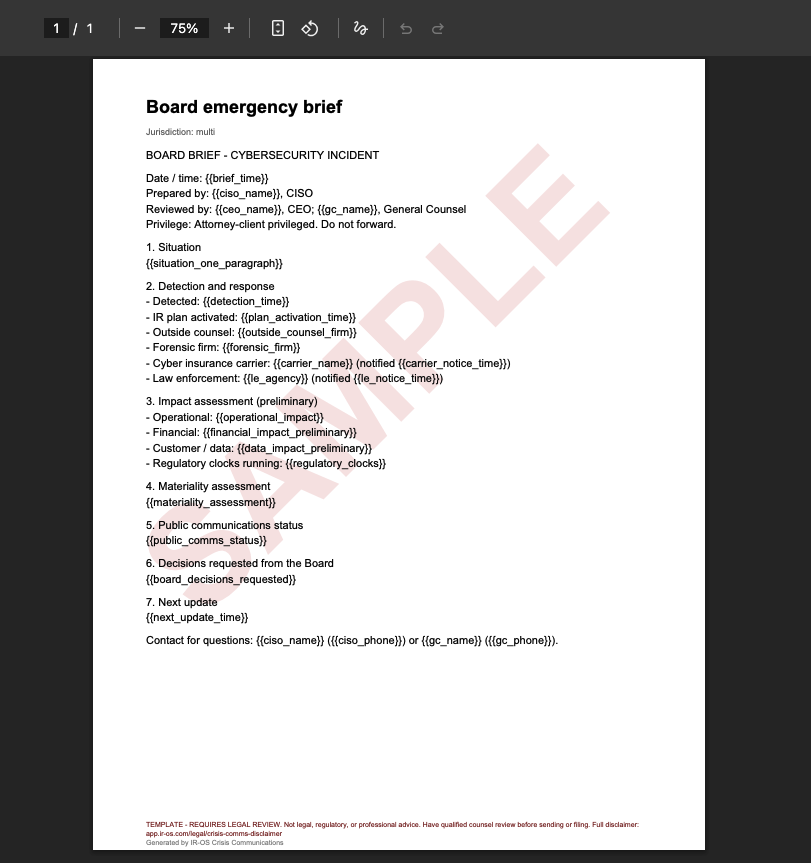
IR-OS Crisis Comms PDF export showing the diagonal SAMPLE watermark and disclaimer footer on every page.
  1. 1
    Diagonal SAMPLE watermark. Drops only once the subscriber clones the template and edits it. Prevents system-template-derived drafts from being mistaken for finalized statements.
  2. 2
    Disclaimer footer rides every page. "Generated from IR-OS template. Subscriber-cloned. Sent from subscriber's domain."
  3. 3
    Subscriber sends from their own domain. IR-OS never delivers external comms. No SendGrid, no SMS, no regulator portal automation. Structural refuse-to-build.

    Capabilities

  • 23 attorney-shape templates. Holding, customer breach letter, SEC 8-K Item 1.05, GDPR Article 33, HIPAA, NY DFS, state AG, public statement, internal update, board brief.
  • Privilege chain at SHA-256. Legal, Comms, and Executive signoffs are events on the chain. One signoff pass per draft.
  • Watermarked exports until cloned. SAMPLE watermark on system-template-derived drafts. Drops on subscriber-cloned edits.
  • PDF/DOCX with provenance. Footer rides every page. Hash of the source draft embedded in the export.
  • No outbound delivery. Subscribers cut/paste, copy, or download and send from their own domain. Regulator portals are always submitted by the subscriber.
  • In-incident integration. The Crisis Comms tab on an open incident pre-loads the templates that the runbook flagged as required.
IR-OS, 2026.
15
IR-OS REVIEWER'S GUIDE
Feature - Regulatory Clocks
2026
Feature deep-dive 07 / 08

Parallel regulatory clocks.

Six-plus clocks running at once.

Most CIRM and SRE-adjacent tools track one regulatory window. Cyber-IR teams routinely run six-plus clocks in parallel. SEC 8-K Item 1.05 (four business days from materiality determination), GDPR Article 33 (72 hours), NY DFS (72 hours), HIPAA (variable by record count), PCI DSS (variable by card-data scope), state breach laws (variable), NIS2 (24h initial / 72h updated / 30d final), DORA (4h initial / 72h intermediate / 1mo final), CIRCIA (72h covered cyber incident). Each clock cites its source paragraph. Each clock pauses and resumes on declared materiality changes.
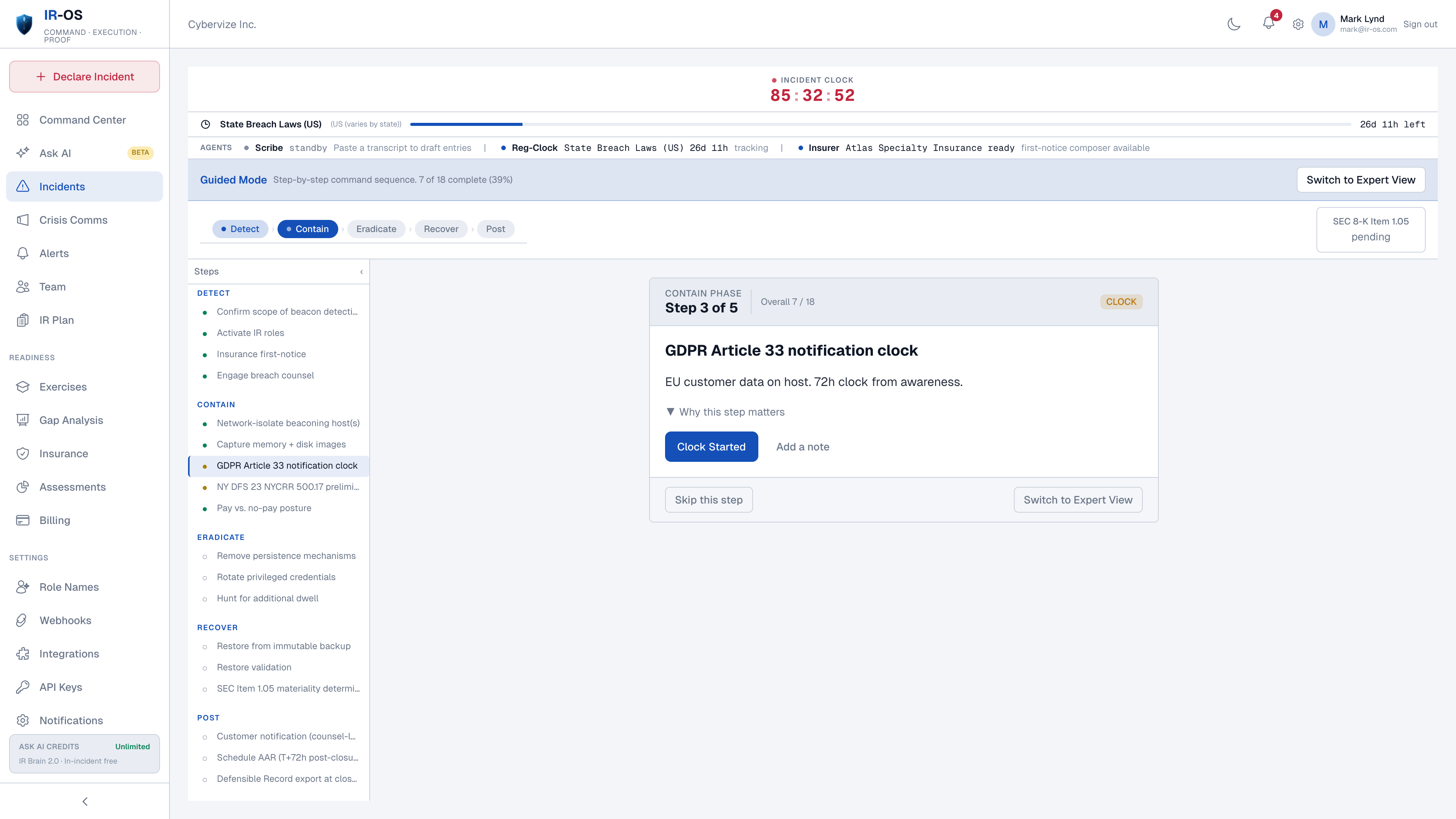
IR-OS Incident Detail page showing the active runbook, MITRE ATT&CK tags, and parallel regulatory clocks anchored at the top.
  1. 1
    Active runbook step list. Steps tagged to MITRE ATT&CK and D3FEND. Pre-built runbooks cover ransomware, data breach, BEC, insider threat, supply chain, cloud compromise.
  2. 2
    Parallel clocks. SEC, GDPR, NY DFS, HIPAA, PCI surfaced together. Each cites the source regulation paragraph.
  3. 3
    Insurance first-notice clock surfaces at declaration alongside panel vendors and exclusions, derived from policy ingest.
  4. 4
    Materiality determination. Clocks compute from a CISO/GC materiality call, not from alert arrival. Auto-pause and resume on declared changes.
Sources. SEC Final Rule 33-11216, Cybersecurity Risk Management, Strategy, Governance, and Incident Disclosure (2023). GDPR Articles 33 and 34. NY DFS Cybersecurity Regulation 23 NYCRR 500. HIPAA Breach Notification Rule, 45 CFR 164.400. PCI DSS v4.0 Requirement 12.10. EU NIS2 Directive 2022/2555. EU DORA Regulation 2022/2554. US CIRCIA, 6 USC 681b.
IR-OS, 2026.
16
IR-OS REVIEWER'S GUIDE
Feature - Defensible Record
2026
Feature deep-dive 08 / 08

Defensible record and /verify.

Public verifier. No account required.

An append-only event ledger with SHA-256 hash chaining enforced by Postgres triggers, not the application layer. The application cannot bypass the chain. Tenant isolation is enforced by row-level security. Every incident is signed at closure with Ed25519. The chain is verifiable publicly at app.ir-os.com/verify with no account. Verification runs in the browser via WebCrypto. The bundle never leaves the verifying party's machine.
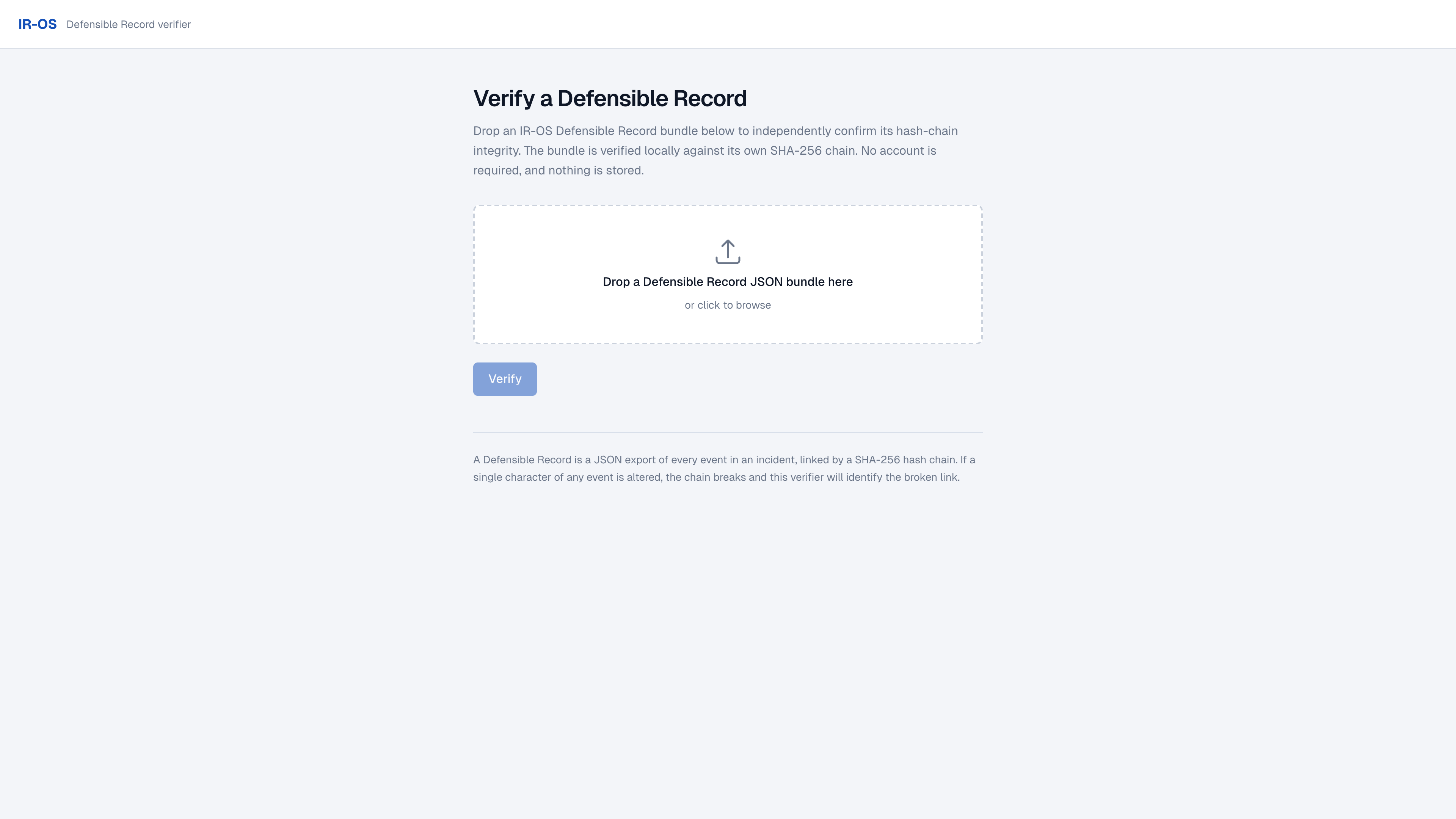
IR-OS public verifier at app.ir-os.com/verify, showing client-side hash chain validation results.
  1. 1
    Public verifier. No account required. Any party with a chain bundle can verify in a browser, anonymously.
  2. 2
    Client-side WebCrypto. The bundle never uploads. The verification is done locally. The platform cannot manipulate the result.
  3. 3
    One URL satisfies SEC, state AG, carrier, plaintiffs counsel. The same artifact serves every downstream audience. Document production in hours, not weeks.

    Architecture

  • SHA-256 hash chain. Each event's hash includes the prior event's hash. A modified event invalidates every subsequent hash.
  • Postgres trigger enforcement. The chain is computed at insert time at the database layer. The application cannot bypass.
  • Append-only. No update. No delete. Corrections are new events that supersede with reference to the original.
  • Tenant isolation. Row-level security. A query cannot return another tenant's events even if the application asks.
  • Ed25519 closure signature. At incident closure, the chain is signed with a key the subscriber controls.
  • Public verifier. /verify with no account. WebCrypto in browser. Bundle stays local. Useful for regulators, carriers, and counsel.
IR-OS, 2026.
17
IR-OS REVIEWER'S GUIDE
A Tale Of Two Incidents
2026
The case for IR-OS

A tale of two incidents.

The same hypothetical incident at a 500-person mid-market with regulated data: a credentials-via-phish breach surfaced by EDR at 22:14 on a Sunday. On Slack, Confluence, and email at left. On IR-OS at right.

When
Without IR-OS - Slack, Confluence, email
With IR-OS
MIN 0
EDR alert hits Slack #security-alerts. On-call analyst paged. No org-level declaration.
Analyst declares an incident from mobile. Six IRC roles auto-assign with backups paged. Hash-chained ledger started.
MIN 5
Analyst tries to reach the IR Lead. PTO. No backup. Pages the security manager.
IC backup is in. Privileged channel created. Outside counsel paged on the privileged path. Privilege is structural.
MIN 14
Manager finds the IR plan in Confluence. Two role owners are no longer in the company.
Insurance first-notice clock surfaced. Panel vendors listed. Deductible visible. Forensics retainer engaged.
MIN 31
Standup starts in a non-privileged Slack channel. The first 31 minutes are off-record.
Time to Command achieved at minute one. Standup runs on the platform. All decisions are events on the chain.
HOUR 3
Comms Lead drafts a holding statement in Google Docs. Four reviewers comment. Recall fails on a CC chain. Privilege bleeds.
Holding statement loaded from the 23-template library. Legal-Comms-Executive signoff in one pass. SHA-256 privilege chain. Watermarked PDF.
HOUR 8
Six senior staff spend the day reconstructing the timeline by hand for the seven o'clock board call.
Board brief auto-renders from the chain. Reconstruction time approaches zero because reconstruction is not necessary.
HOUR 24
Carrier first-notice missed by 2 hours. Reservation of rights letter issued. $50K-$500K coverage at risk.
Carrier first-notice filed inside policy window with chain bundle attached. Coverage preserved.
DAY 7
SEC 8-K Item 1.05 materiality determination is contested internally. No clean record of who knew what when.
Materiality determination is an event on the chain with the GC's signature. The record speaks.
DAY 30
Outside counsel reconstructs the timeline for SEC, state AG, and the carrier from logs and screenshots. $200K-$500K bill.
/verify URL provided to SEC, state AG, and carrier. Document production in hours.
DAY 60
Plaintiffs counsel files. Spoliation argument lands on the missing privilege chain. Discovery scope expands.
Plaintiffs receive the chain bundle. Privileged drafts stay structurally privileged. Spoliation argument fails.
DAY 90
Carrier disputes plan-followed evidence. Coverage shortfall: $1M+.
Plan-followed evidence is the chain itself. Insurance claim approved on the chain.
IR-OS, 2026.
18
IR-OS REVIEWER'S GUIDE
The ROI Math
2026
The CFO conversation

The ROI math, for the CFO.

Representative dollar ranges for a 500-person mid-market subscriber with one major incident inside a three-year platform commitment. Numbers drawn from Coalition Cyber Claims Report 2024, IBM Cost of a Data Breach 2024, and breach-counsel reconstructions on file with the Advisory Board. Ranges, not point estimates.

Per-incident exposure avoided

Cyber insurance coverage preserved on the chain
$500K - $2M
Outside counsel reconstruction (Day 30 SEC/AG/carrier filings)
$200K - $500K
Plaintiffs discovery scope reduction (Day 60)
$300K - $1M
Senior-staff Day 1 time savings (8 person-hours x partner rate)
$50K - $150K
Regulatory penalty risk reduction (SEC, state AG, GDPR)
Variable
Per-incident avoided exposure (range)
$1.05M - $3.65M+

Annual platform cost

Squad ($299/mo)
$3,588 / year
Command ($499/mo)
$5,988 / year
Theater ($799/mo)
$9,588 / year
3-year platform cost (Command tier)
$17,964
Net per-incident return (Command tier)
58x - 200x+
What this calculation excludes. Reputation cost. Customer churn after a public incident. Executive turnover, which we sourced as the most underestimated downstream cost in the post-incident reviews we read. Board-level governance cost (committee meetings, special counsel engagements). Each of these is real and individually larger than the platform cost. We exclude them not because they are negligible but because they are difficult to bound. Even at the conservative end of the included items, the math is decisive.
Sources. Coalition Cyber Claims Report 2024 (mid-market loss ratios). IBM Cost of a Data Breach 2024 (breach lifecycle and cost-by-stage). Verizon DBIR 2024 (incident type prevalence). Operational benchmarks and dollar ranges synthesized from breach-counsel reconstructions on file with the Advisory Board.
IR-OS, 2026.
19
IR-OS REVIEWER'S GUIDE
Category Comparison
2026
The category question

IR-OS versus the SRE incumbents.

PagerDuty, incident.io, FireHydrant, and Jira are the tools cyber-IR teams most often inherit. Three are SRE-native. One is a general-purpose project tracker. None were built for the regulator, the carrier, or the room where decisions are made under privilege. The structural mismatch shows up consistently in the comparison below. FireHydrant was acquired by Freshworks in December 2025 and becomes the Freshservice ITSM layer in Q1 2026; the migration window for cyber-IR teams is open and shrinking.

Capability IR-OS PagerDuty incident.io FireHydrant Jira
Built for Cyber IR SRE / on-call SRE SRE (now ITSM) General PM
Hash-chained event ledger Yes - DB enforced No No No No
Crisis-comms templates (attorney-shape) 23 0 0 0 0
Privilege chain on signoffs SHA-256, structural No No No No
AI grounding Citation + private org data None / limited Limited None None
Parallel regulatory clocks SEC, GDPR, NY DFS, HIPAA, PCI, NIS2, DORA, CIRCIA No No No No
Cyber insurance ingest at declaration Yes - first-notice clock, panel vendors, exclusions No No No No
Public chain verifier (no account) app.ir-os.com/verify, WebCrypto No No No No
Auto-AAR with writeback to plan Yes - 8-section, plan rewrites Postmortem template Postmortem template Postmortem template No
Tabletop exercise engine 12+ pre-built scenarios No No No No
Built from 150+ C-suite tabletops SRE on-call data SRE on-call data SRE on-call data General PM
Sources. Vendor product documentation as of Q1 2026. FireHydrant acquisition: Freshworks press release, December 2025; product roadmap consolidation announced Q1 2026. Capability claims for incident.io and PagerDuty drawn from public docs and prior independent reviews on file. Jira incident-management capability evaluated against the Atlassian Jira Service Management product line.
IR-OS, 2026.
20
IR-OS REVIEWER'S GUIDE
What IR-OS Will Not Do
2026
Refuse-to-build

What IR-OS deliberately will not do.

A list of things IR-OS could ship but has chosen not to. We treat this as a credibility signal. Each entry is a deliberate refuse-to-build, with a stated reason. Categories that promise everything end up shipping nothing well. The list below is what makes the rest of the platform trustworthy.

  1. Will not ingest the org chart.

    Ingesting an HR roster creates data risk with no privilege protection and breaks the moment the subscriber reorganizes. The Role Recommender recommends job titles. The subscriber names the person.

  2. Will not select named employees for IRC roles.

    Employee selection requires HR data the platform should never hold. The subscriber controls every name on the page, with backup enforcement at plan-publish time.

  3. Will not deliver external communications.

    No SendGrid. No SMS. No regulator portal automation. Subscribers cut/paste, copy, or download PDF/DOCX and send from their own domain. The send is the subscriber's accountability, not the platform's.

  4. Will not generate AI answers without citations.

    Fabrication is malpractice in cyber IR. Every Ask AI answer cites its source. If the question requires reasoning outside the corpus, the platform flags it explicitly and refuses to invent a paragraph.

  5. Will not redact comms mid-flight.

    Mid-flight redaction is governance theater and a spoliation argument waiting to happen. Comms move through the privilege chain or they do not move at all. The chain is the chain.

  6. Will not let responders assert privilege after the fact.

    Privilege is structural in IR-OS. The platform creates the privileged channel at declaration. Privilege is not asserted by a checkbox the IC may or may not remember to tick.

  7. Will not replace SIEM, EDR, or SOAR.

    Different category. SIEM, EDR, and SOAR answer "what is happening?" CIRM answers "who decides, when, and how do we prove it?" IR-OS complements those tools. It does not compete with them.

  8. Will not target SRE incidents.

    SRE incidents belong in PagerDuty or incident.io. IR-OS does not optimize for mean time to detect or mean time to resolve. It optimizes for defensibility under privilege. Different problem.

IR-OS Crisis Communications disclaimer modal explicitly stating that the platform does not deliver external communications and that the subscriber sends from their own domain.

The disclaimer modal Crisis Communications surfaces to subscribers. The most concise expression of refuse-to-build number three on this page: the platform does not deliver external communications. Subscribers send from their own domain.

IR-OS, 2026.
21
IR-OS REVIEWER'S GUIDE
Pricing And Packaging
2026
What it costs

Pricing and packaging.

Three tiers. Squad for the small team that needs the discipline. Command for the mid-market that runs incidents through the year. Theater for the multi-business-unit organization with a board view, SSO, and a private corpus. 7-day free trial on every tier. Card required up front. Cancel before day 7. 30-day money-back guarantee on every plan.

Squad.

For the small team
$299/moflat
  • Up to 4 users, 1 IRC team
  • 5 incidents/year, 2 tabletops/year
  • 50 Ask AI credits/month (unlimited during active incidents)
  • All 3 plan templates (Expert, NIST, ISO)
  • AI Plan Coach
  • IRC Role Recommender
  • Hash-chained defensible record
  • Auto-AARs with writeback to plan
  • 7-day free trial
  • 30-day money-back guarantee

Command.

For the mid-market
$499/moflat
  • Up to 20 users, multiple IRC teams
  • Unlimited incidents, 4 tabletops/year
  • 200 Ask AI credits/month (unlimited during active incidents)
  • Everything in Squad, plus:
  • 7 pre-built playbooks (ransomware, breach, BEC, insider, supply chain, cloud, BEC variants)
  • IOC tracking and alert ingestion
  • Evidence chain of custody
  • Parallel regulatory clocks (SEC, GDPR, NY DFS, HIPAA, PCI)
  • Cyber insurance integration (first-notice clock, panel vendors)
  • 7-day trial. 30-day refund.

Theater.

For multi-BU at scale
$799/moflat
  • Unlimited users, IRC teams, incidents, tabletops, Ask AI
  • Everything in Command, plus:
  • Multi-BU parent hierarchy with unified board view
  • SSO/SAML/SCIM
  • Private IR Brain corpus (subscriber's runbooks, prior AARs)
  • NERC CIP, TSA, CIRCIA, DORA regulatory mappings
  • Dedicated CSM
  • 24x7 support
  • SOC 2 Type II + compliance package
  • 7-day trial. 30-day refund.
Trial terms.
Card required up front, charged on day 8 unless cancelled. The trial is the full product. No feature gating during trial.
Refund terms.
30-day money-back guarantee on every plan. Submitted via support; refund processed inside 5 business days. No retention scripts.
IR-OS, 2026.
22
IR-OS REVIEWER'S GUIDE
Five Managed AI Agents
2026
Continuous, not on-demand

Five managed AI agents.

IR-OS runs five AI agents continuously inside each tenant. Each is grounded in the corpus and the subscriber's own data, and each writes events to the chain when it acts. None of them ship a generic chat surface. They sit at specific points in the workflow where the human is most likely to skip a step under pressure.

AGENT 01

AAR Builder.

Auto-generates the 8-section After-Action Review when the IC closes the incident. Eight sections drawn from NIST SP 800-61 Rev. 2: detection, scope, eradication, recovery, lessons, plan changes, regulatory observations, board summary.

Writes back to: the IR plan, the runbook library, and the board archive.
AGENT 02

AI War Room Copilot.

Sits in the active incident surface. Surfaces the next required action from the runbook, the next regulatory clock that will fire, and any required signoff that is overdue. Refuses to act without IC confirmation. Writes its prompts to the chain.

Writes back to: the active incident timeline, the regulatory clock state.
AGENT 03

Tabletop Facilitator.

Runs tabletop exercises against the subscriber's own plan and roster. 12-plus pre-built scenarios. The agent injects realistic curveballs, including a missing IC, a contested materiality call, and a recall failure on a holding statement. Outputs a tabletop AAR.

Writes back to: the readiness scorecard, the open-gaps list.
AGENT 04

Threat Watcher.

Monitors threat intelligence feeds for indicators relevant to the subscriber's profile (sector, regulators, third-party dependencies). When a relevant pattern emerges, the agent suggests a tabletop exercise tuned to the new pattern, not a generic alert.

Writes back to: the readiness scorecard, the tabletop schedule.
AGENT 05 - THEATER TIER

Private IR Brain Corpus Learner.

On Theater, an additional agent ingests the subscriber's own runbooks, prior AARs, and proprietary operational patterns into a tenant-isolated corpus. Future Ask AI queries fuse the canonical corpus, the active incident facts, and this private corpus, with citations that distinguish the three sources. Tenant isolation enforced via row-level security. The private corpus never crosses tenant boundaries.

Writes back to: the tenant-private corpus, with provenance metadata on every embedded chunk.
IR-OS, 2026.
23
IR-OS REVIEWER'S GUIDE
Evaluating IR-OS
2026
For the buyer

How to evaluate IR-OS in 30 minutes.

A concrete trial protocol. Five steps. Each step has a specific thing to look for. At the end of 30 minutes the reader should know whether to advance to a fuller pilot or to walk away. We recommend running this protocol with a CISO and a GC in the same room.

  1. Run the AI Plan Coach.

    Pick the Expert template starting point. Answer the 12 interview questions for your real organization. Confirm the resulting plan maps cleanly to NIST SP 800-61 and the regulators in your scope.

    What to look for Did the plan name your regulators correctly? Does it include parallel-clock structure for SEC and GDPR if applicable? Is the language plausibly defensible if your GC read it tomorrow?
  2. Use the IRC Role Recommender.

    Walk through the six IRC functions. Confirm the recommended job titles match what your organization actually has, then name the people. Verify backup enforcement.

    What to look for Does the platform refuse to publish without backups? Do the recommendations adapt sensibly to your size (200 versus 5000 person)? Did you have to create a synthetic role to fit?
  3. Declare a synthetic incident.

    Pick the ransomware runbook. Walk through the first 30 minutes. Read the chain after each action.

    What to look for Time to Command under one minute. Insurance first-notice clock visible at declaration. Privileged channel created automatically. Each action shows up on the chain in real time.
  4. Generate one external comm.

    Open the Crisis Communications surface. Pick the customer breach letter template. Clone, edit, route through Legal-Comms-Executive, export the PDF.

    What to look for SAMPLE watermark drops once you clone and edit. Privilege chain shows three signoffs at SHA-256 granularity. Provenance footer rides every page of the export.
  5. Verify the chain at /verify.

    Close the synthetic incident. Download the chain bundle. Open app.ir-os.com/verify in a fresh browser without logging in. Drop the bundle.

    What to look for Verification runs in your browser. The bundle does not upload (check DevTools network tab). Tampering with one event invalidates every subsequent event. The same artifact would satisfy SEC, AG, carrier, and counsel.
IR-OS, 2026.
24
IR-OS  ·  2026 Reviewer's Guide Page 25 / 25
Reviewer's Verdict

After twelve hours inside IR-OS, against a standard defined by SEC Final Rule 33-11216, GDPR Article 33, NY DFS 23 NYCRR 500, and the operational reality of 150-plus C-suite tabletops, our verdict is unambiguous. IR-OS is the first platform we have reviewed that solves the right problem.

It will not replace the SIEM. It will not detect the breach. It will not deliver the email. It does what no SRE-derived tool can do: it captures decisions under privilege, it runs the regulatory clocks in parallel from the source paragraphs, and it produces a chain that satisfies the SEC, the state AG, the carrier, and plaintiffs counsel from one URL.

The price is small. The downside of evaluating it is small. The downside of not evaluating it, in our judgment, is the post-incident bill that arrives in the mail on Day 90. A reader who does not run the 30-minute trial protocol on page 24 is taking on more risk by inaction than by action.

Start the trial

7-day free trial on every plan. Card required up front. Cancel anytime before day 7. 30-day money-back guarantee. Begin at app.ir-os.com.

About the analyst

Independent senior cyber-IR reviewer. Twenty-plus years across CISO, GC liaison, and incident-response roles. Reviewed seven cyber-IR platforms in the past two years. Disclosure below.

Disclosure. The analyst was given trial access to IR-OS to write this guide and was compensated for the time spent reviewing it. The analyst retained full editorial control. IR-OS did not see this guide before publication. Numbers and ranges are sourced from the citations in the body. Any reader who wishes to reproduce the findings can do so via the 30-minute trial protocol on page 24.

Command. Execution. Proof. app.ir-os.com